Heads up! I’m creating short, fun, Come Follow Me videos each week. Be notified of new videos via email, Facebook, or Instagram.
The below transcript comes from this video, and draws on material from my book, The Founder of our Peace.
What do you regret? Maybe it’s something simple, like eating too much food, or staying up too late last night. Or perhaps it’s not buying stock in a certain company twenty years ago—you could have been rich! Or more significantly maybe you did something—or didn’t do something—in a relationship that fills your heart with regret. Sometimes we tell ourselves, “If only I had been smarter (or worked harder, gotten up earlier, been more aggressive, and so on), then things would have been different. It’s certainly possible that with respect to one specific choice, we could have received a better outcome. But it’s unrealistic to think that we’re going to always make regret-free decisions.
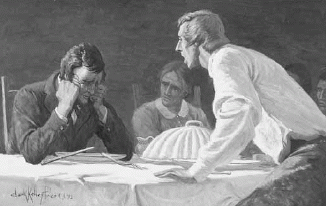
Even the Prophet Joseph Smith had serious regrets, such as when 116 pages of the Book of Mormon manuscript were lost. Joseph prayed about whether he should give Martin Harris the translated manuscript and felt that he should not do it. But Joseph was only twenty-two years old, and under incredible pressure he eventually gave Martin the 116 pages, which were then lost. In some respects, this was an irreversibly bad decision—the 116 pages were never recovered. You, me, and every Church member—we all wish we had these pages. After losing the pages, Joseph was distraught and exclaimed, “All is lost.”
On the other hand, Joseph’s choice to give Martin the manuscript has not done long-term damage. God anticipated this would happen and prepared an alternate solution (see 1 Nephi 9:5; Words of Mormon 1:3–7; Doctrine and Covenants 3:1). The Book of Mormon as we have it is a marvelous book, and in his later life, Joseph rarely mentioned this incident. Put in the context of his entire life, the lost 116 pages were not that big of a deal.
After Joseph Smith lost the 116 pages, the Lord said to him, “Thou art still chosen, and art again called to the work” (Doctrine and Covenants 3:10), and he encouraged Joseph to be “faithful and continue on” (Doctrine and Covenants 10:3). All of us do things we regret. Joseph’s poor decision at age twenty-two did not define his life, and the choices we make in our early twenties (or at any other time) need not define ours. Consider this story:
As a college student, Laura had a boyfriend named Adam. They talked about marriage, but Laura didn’t feel ready to commit and asked for a three-month separation to think things over. During that time, Adam started dating another woman, and he eventually married her. Initially, this didn’t bother Laura; however, years later, she is still single and constantly wonders, “What if I hadn’t hesitated with Adam?”
Maybe Laura would have been happier had she made a different choice, but maybe not. Many of us have the tendency to think endlessly about how things could have been different. Psychologists call this counterfactual thinking, which is analyzing what would have happened if only you (or somebody else) had made a different choice. When we think this way, we create alternate realities that will never exist. Laura is engaging in counterfactual thinking when she thinks life would be better if she had married Adam.
When I find myself engaging in counterfactual thinking, I find it helpful to ask myself, “Can I really know for sure that things would have been better if only _____(insert whatever I’m regretting)?” In some cases, the things we regret may actually turn out for our good. In Laura’s case, she could ask herself, “Can I really know for sure that things would have been better if had married Adam?” There is no way to know what might have been and as Rafiki says, “It’s in the past.” We can’t change it but we can learn from it.”
Although everyone has regrets, we can choose what we will do with them and how we will move forward. I love this advice from President M. Russell Ballard: “Regardless of how hard you try, you can’t change the past. What I want you to learn to do is look upstream. Watch for the things that are coming down the river of life that you can change and control.”
Yes, if we had known in the past what we now know, we could have made better decisions. Joseph could have kept the 116 pages—but even though Joseph made a serious mistake, the Lord encouraged him by saying, “Thou art still chosen, and art again called to the work” (Doctrine and Covenants 3:10). God told Joseph to be “faithful and continue on” (Doctrine and Covenants 10:3). These same words apply to each of us.
In the context of the lost 116 pages, the Savior said to the prophet Joseph, “I am Jesus Christ, the Son of God…I am the light which shineth in darkness” (Doctrine and Covenants 10:57–58) and “Remember the words of him who is the life and light of the world, your Redeemer, your Lord and your God” (Doctrine and Covenants 10:70). Even though things may seem dark at times we do not need to be filled with regret. The Light of the World stands ready to help us. When we feel regret for choices we’ve made, we can gently remind ourselves that (1) we all do things we regret, (2) in the context of our entire life, any one mistake does not define us, and (3) Jesus is calling us to be “faithful and continue on.”
To learn more about dealing with regret, check out my book, The Founder of our Peace.


