The below is a transcript based on this video.
When Nephi first arrived in the Promised Land, God commanded him to make plates and keep a record of the things that had happened to him. Nephi wrote extensively about his family’s journey through the wilderness, his prophecies, and his father’s prophecies. This took a lot of time and effort. More than twenty years later the Lord told him to make another set of plates—how do you think Nephi felt? I wonder if Nephi questioned the Lord—I would have been tempted to say something like, “Are you sure Lord? It’s a lot of effort to make plates and engrave them. I’ve been working on my current record for twenty years. Are you sure you want a second set?”
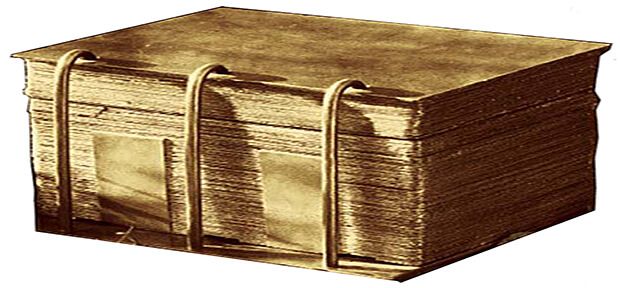
But Nephi obeyed and created a second set of plates, which Jacob would later refer to as “the small plates” (Jacob 1:1). Nephi’s first record was larger and more extensive. However, the second record, the small plates, contained “the more part of the ministry” (1 Nephi 9:4) and “more plain and precious parts” of his prophecies (1 Nephi 19:3).
Why did Nephi have to make two sets of plates? He himself didn’t know. In fact, Nephi said, “Wherefore, the Lord hath commanded me to make these plates for a wise purpose in him, which purpose I know not” (1 Nephi 9:5) .
Almost 1,000 years later, Mormon was busy compiling the record that we would one day receive as the Book of Mormon. Using Nephi’s first set of plates as a source record, he had abridged, or summarized everything from when Lehi’s family first left Jerusalem down to the time period of King Benjamin. At this point in his record keeping, Mormon discovered the second set of plates—the small plates, that Nephi had made. He said that the things that were on the small plates were pleasing because of the prophecies of Jesus Christ that had been fulfilled. The Spirit prompted Mormon to include the small plates in his record. Mormon wrote, “I shall take these [small] plates, which contain these prophesyings and revelations, and put them with the remainder of my record, for they are choice unto me; and I know they will be choice unto my brethren. And I do this for a wise purpose; for thus it whispereth me, according to the workings of the Spirit of the Lord which is in me” (Words of Mormon 1:6–7).
Note that phrase “a wise purpose”—the same phrase that Nephi had used earlier. Like Nephi, Mormon didn’t know why he was including the small plates, but he had confidence that “the Lord knoweth all things which are to come” (Words of Mormon 1:7) and so he followed through on this prompting.
Are you following the story so far? In approximately 570 BC, Nephi feels prompted to make a second record of his prophecies. He doesn’t know why he’s doing it, but he knows it’s for “a wise purpose” in the Lord. Almost 1,000 years later, Mormon feels prompted to include Nephi’s second record. He doesn’t know why he’s doing it, but he knows it’s for “a wise purpose” in the Lord.
Let’s jump forward about 1,500 years in time. It’s now 1828. Over the past several months Joseph Smith has been translating the Book of Mormon and now had 116 pages of completed translation. What they had translated was Mormon’s abridgement, or summary of the first set of records Nephi had created—covering the time period from Nephi to King Benjamin.
A man named Martin Harris had been helping Joseph as a scribe; Martin had also given significant financial aid to Joseph. Martin’s wife was skeptical of the venture; Martin asked Joseph if he could borrow the 116 pages and show them to his wife. Joseph felt uneasy about this idea, but he eventually gave in to Martin’s request.
To make a long story short, the 116 pages were lost or stolen, never to be found again. What was to be done? The entire record from Nephi down to King Benjamin had disappeared! But as the Lord revealed to Joseph Smith at this time, “The works, and the designs, and the purposes of God cannot be frustrated, neither can they come to naught” (Doctrine and Covenants 3:1). God already knew that the 116 pages would be lost—and so he had prompted Nephi and Mormon—centuries in advance to make a backup plan. The small plates of Nephi—his second record, covered approximately the same time period as the lost 116 pages.
What are some lessons that we can learn from this story? Consider these three.
- God already knows that we are going to make mistakes, and has prepared the way for us to succeed in spite of our failures. We don’t need to be devastated when we mess up.
- We should follow the promptings we receive. Because Nephi and Mormon followed through on the impressions they felt, we are blessed today.
- God doesn’t always tell us “why” we are supposed to do something. He told Nephi and Mormon to make duplicate records, but he didn’t give them a reason. The Lord may have good reasons for not telling us why. I can only imagine Mormon getting frustrated if the Lord told him, “Look, everything you’ve been working on for the past five years? Well, some guy in the future is going to lose it all, so you better make a back up copy.”

- Whether or not we know God’s reasons, we should follow him, knowing that he has “a wise purpose.”
If you or I ever feel like we don’t understand the reasons for the prompting we can receive, we can look to Isaiah 55:8-9 for comfort and reassurance. The Lord has said, “My thoughts are not your thoughts saith the Lord, even as the heavens are higher than the earth so are my thoughts than your thoughts.” As we follow the Holy Ghost, we will be on the right path.


